Table of Contents
Yellowstone and Grand Teton National Parks sit back-to-back in northwest Wyoming, connected by the 8-mile John D. Rockefeller Jr. Memorial Parkway. That proximity is what makes visiting both in one trip so appealing — but the parks are also enormous (Yellowstone alone is bigger than Rhode Island and Delaware combined), so where you sleep each night has a real effect on how much driving you do versus how much time you spend actually exploring.
Here’s a full breakdown of your options.
The Geography, in Brief
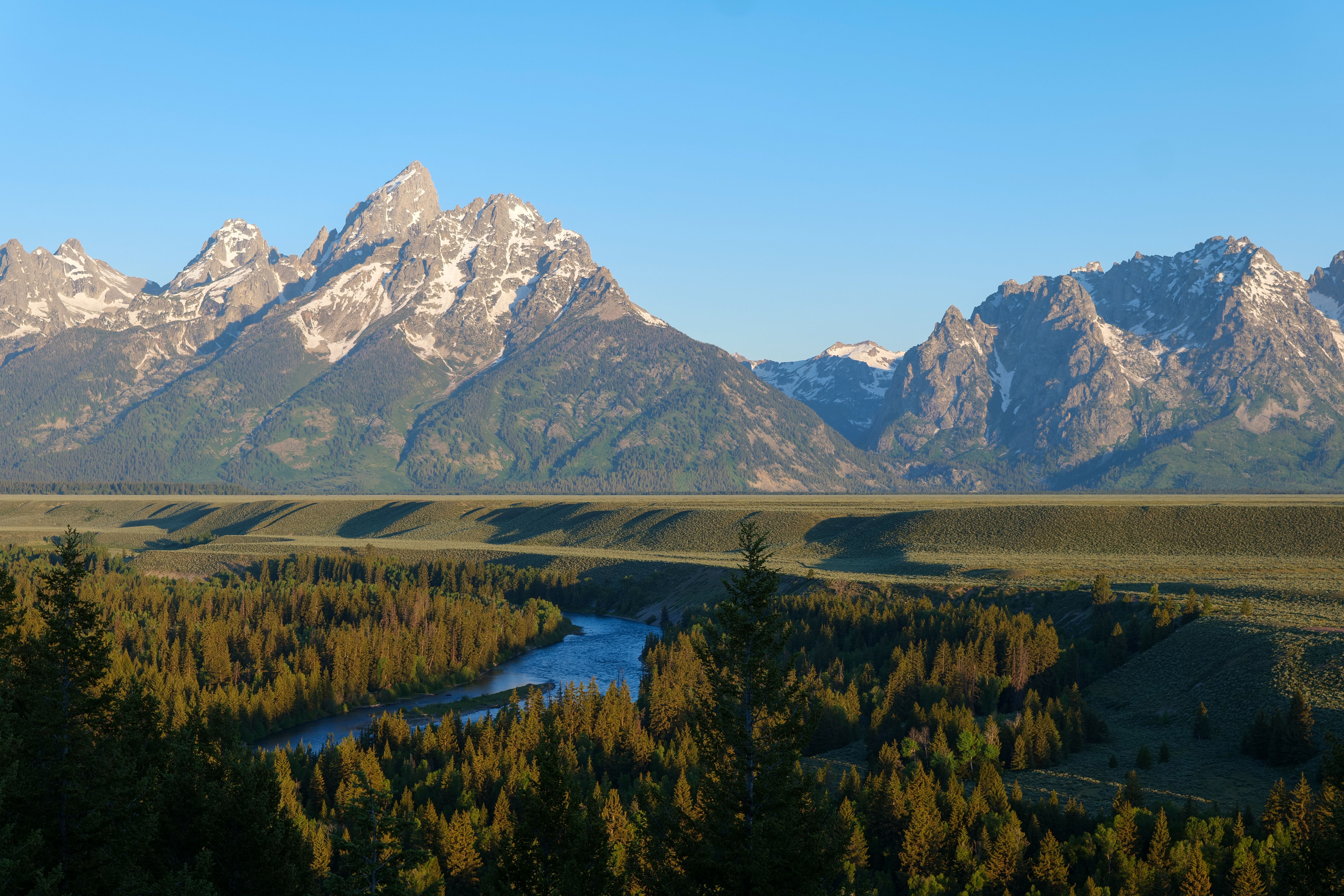
- Grand Teton National Park is compact and centers on the town of Jackson to the south and Jackson Lake to the north.
- Yellowstone National Park is roughly 10x larger, shaped like a rough figure-eight of roads, with major sights (Old Faithful, Grand Prismatic, Mammoth Hot Springs, the Grand Canyon of the Yellowstone) spread across a 2–3 hour drive from end to end.
- The two parks connect directly: Grand Teton’s north entrance flows into Yellowstone’s south entrance via the parkway, with no towns in between.
Because of this layout, there’s no single town that’s “close” to everything — you’re choosing between convenience for one park versus the other, or splitting your stay.

Your Main Basing Options
1. Jackson, WY — the all-around best base
Jackson is about an hour from Grand Teton’s Moose entrance and roughly 2.5 hours from Yellowstone’s major geyser basins. It has by far the most infrastructure: hundreds of hotels across every price range, a strong restaurant scene, an airport (JAC) with direct flights from major cities, and things to do on rest days (the town square, art galleries, the aerial tram at Jackson Hole Mountain Resort).
Best for: first-time visitors, people who want variety in food/lodging, anyone flying in and renting a car locally.
Trade-off: the farthest option from Yellowstone’s interior, meaning long days if you want to see the far north or west sides of the park.
2. Inside Grand Teton (Colter Bay Village, Jackson Lake Lodge, Signal Mountain Lodge)
Staying inside the park itself, especially near Jackson Lake, puts you roughly midway between Jackson and Yellowstone’s south entrance.
This meaningfully cuts driving time on days you’re bouncing between parks.
Best for: travelers prioritizing minimal driving and park scenery right outside the door.
Trade-off: simpler, pricier-for-what-you-get lodging (cabins, motel-style rooms), limited dining options, and these fill up fast — often 6–12 months ahead for summer.
3. West Yellowstone, MT — best if Yellowstone is your priority
Sitting directly at Yellowstone’s west entrance, this gateway town puts you close to Old Faithful, the geyser basins, and the Grand Canyon of the Yellowstone.
It has a good range of hotels and restaurants for a small town, plus an airport with seasonal service.
Best for: trips weighted more heavily toward Yellowstone, with the Tetons as a single day trip (about 1.5–2 hours to Jackson).
Trade-off: the farthest reasonable option from Grand Teton, and it’s a quieter, more functional town than Jackson.
4. Gardiner, MT — best for Yellowstone’s north loop
At Yellowstone’s north entrance, Gardiner is close to Mammoth Hot Springs and the wildlife-rich Lamar Valley.
It’s also the only entrance open to cars year-round, which matters if you’re visiting in winter.
Best for: wildlife-focused trips and access to Yellowstone’s northern sights.
Trade-off: about 3 hours from Grand Teton — really only makes sense if the Tetons are a minor add-on rather than a co-equal priority.

5. Cody, WY — a scenic but less central choice
East of Yellowstone, Cody offers a different (and famously beautiful) approach via the Buffalo Bill Scenic Byway, plus its own Old West attractions.
It’s a good pick if you’re arriving from that direction, but it adds real distance to Grand Teton.
Best for: road-trippers coming from the east, or those wanting an Old West town experience.
Trade-off: least convenient for a two-park trip unless it’s just one leg of a longer route.
Comparing the Options at a Glance
| Base | Distance to Grand Teton highlights | Distance to Yellowstone highlights | Lodging variety | Good for |
|---|---|---|---|---|
| Jackson, WY | ~30–60 min | ~2.5 hrs | Extensive | First-timers, balance, amenities |
| Inside Grand Teton (Colter Bay area) | On-site | ~1–1.5 hrs to south entrance sights | Limited, books early | Minimal driving, scenery |
| West Yellowstone, MT | ~1.5–2 hrs | On-site | Moderate | Yellowstone-focused trips |
| Gardiner, MT | ~3 hrs | On-site (north loop) | Limited | Wildlife, winter access |
| Cody, WY | ~3+ hrs | ~1 hr (east entrance) | Moderate | Eastern approach, Old West stops |
The Strategy That Works Best for Most Trips: Split Your Stay
Rather than commuting long distances daily from one base, most experienced visitors split a week roughly like this:
- Nights 1–3 (or so): Jackson or inside Grand Teton — explore the Tetons (hiking around Jenny Lake, scenic drives, Mormon Row) and do the drive up through the parkway.
- Nights 4–7: West Yellowstone or Gardiner — tackle Yellowstone’s geyser basins, canyon, and wildlife-heavy areas without a long commute each day.
This way you’re never spending more than an hour or two driving to reach that day’s sights, and you get two very different small-town experiences along the way.
Practical Planning Notes
Book early. In-park lodging (Old Faithful Inn, Colter Bay, Lake Yellowstone Hotel, Jackson Lake Lodge) routinely sells out 6–12 months in advance for peak summer (June–August). If you want to stay inside either park, this is the first thing to lock in.
Consider shoulder season. Late May, early June, and September offer thinner crowds, lower prices, and still-good weather, though some high-elevation roads and facilities open/close around these windows — worth checking current park status before booking.
Factor in the parkway drive itself. The stretch between the parks is scenic in its own right, with pull-offs and Teton views — budget time for it rather than treating it as a pure transit leg.
Watch for road closures. Yellowstone’s interior roads can close seasonally (typically open fully by late May/early June and starting to close again in early November), which affects how feasible a “quick loop” is outside summer.
Airports: Jackson Hole Airport (JAC) is the most convenient if you’re starting in the Tetons; Bozeman Yellowstone International (BZN) is a common alternative if you’re starting from the Yellowstone side, about 1.5–2 hours from West Yellowstone.

Bottom Line
- Want one base and minimal fuss? Stay in Jackson.
- Want minimal driving and don’t mind rustic lodging? Stay inside Grand Teton near Jackson Lake.
- Yellowstone is your main draw, Tetons a bonus? Base in West Yellowstone or Gardiner.
- Have 5+ days? Split your stay between a Teton-area base and a Yellowstone-area base — this gives you the best of both without long daily drives.
Leave a Reply